Canadian‑Shipped 🇨🇦 Find Your Ride in 60 Seconds →

Canadian‑Shipped 🇨🇦 Find Your Ride in 60 Seconds →
Canadian‑Shipped 🇨🇦 Find Your Ride in 60 Seconds →

July 23, 2026 5 min read
By Street Rides Research Team | Updated May 2026 | 8 min read
Editorial accountability: Charles Backmann remains the listed author. Daniel Martin is the accountable Street Rides editor. Report a correction.Updated May 2026 with original research from 738 Canadian retail listings
E-bike types are the distinct categories of electric bicycles defined by frame design, tire size, and intended use. Fat tire e-bikes own 36.9% of the Canadian market. Folding bikes take 21.7%. Together they account for 57% of all listings in Canadian retail.
We analyzed 738 electric bikes listed in Canadian retail in May 2026 and classified every listing by category, price, wattage, and brand. The table below shows how each e-bike type compares.
| Category | Listings | Share | Avg Price | Median Price | Best For |
|---|---|---|---|---|---|
| Fat Tire | 272 | 36.9% | $1,764 | $1,599 | Snow, trails, off-road |
| Folding | 160 | 21.7% | $1,108 | $730 | Storage, transit, RVs |
| Trike | 57 | 7.7% | $2,086 | $1,867 | Seniors, cargo, stability |
| Dirt Bike | 55 | 7.5% | $1,251 | $1,099 | Trail riding, recreation |
| Scooter | 52 | 7.0% | $1,159 | $725 | Short commutes, students |
| Mountain | 49 | 6.6% | $1,218 | $926 | Trail riding, sport |
| Commuter | 28 | 3.8% | $1,077 | $909 | Daily work commute |
| Step-Thru | 12 | 1.6% | $850 | $700 | Accessibility, casual |
For the full market breakdown with pricing tiers, brand analysis, and seasonality data, read our State of the Canadian E-Bike Market 2026 report.
E-bike categories in Canada follow four common differentiators: frame design, wheel size, motor placement, and intended riding surface. Each choice affects price, weight, range, and legal fit under federal power-assisted bicycle rules. This guide walks through each type with clear buyer signals.
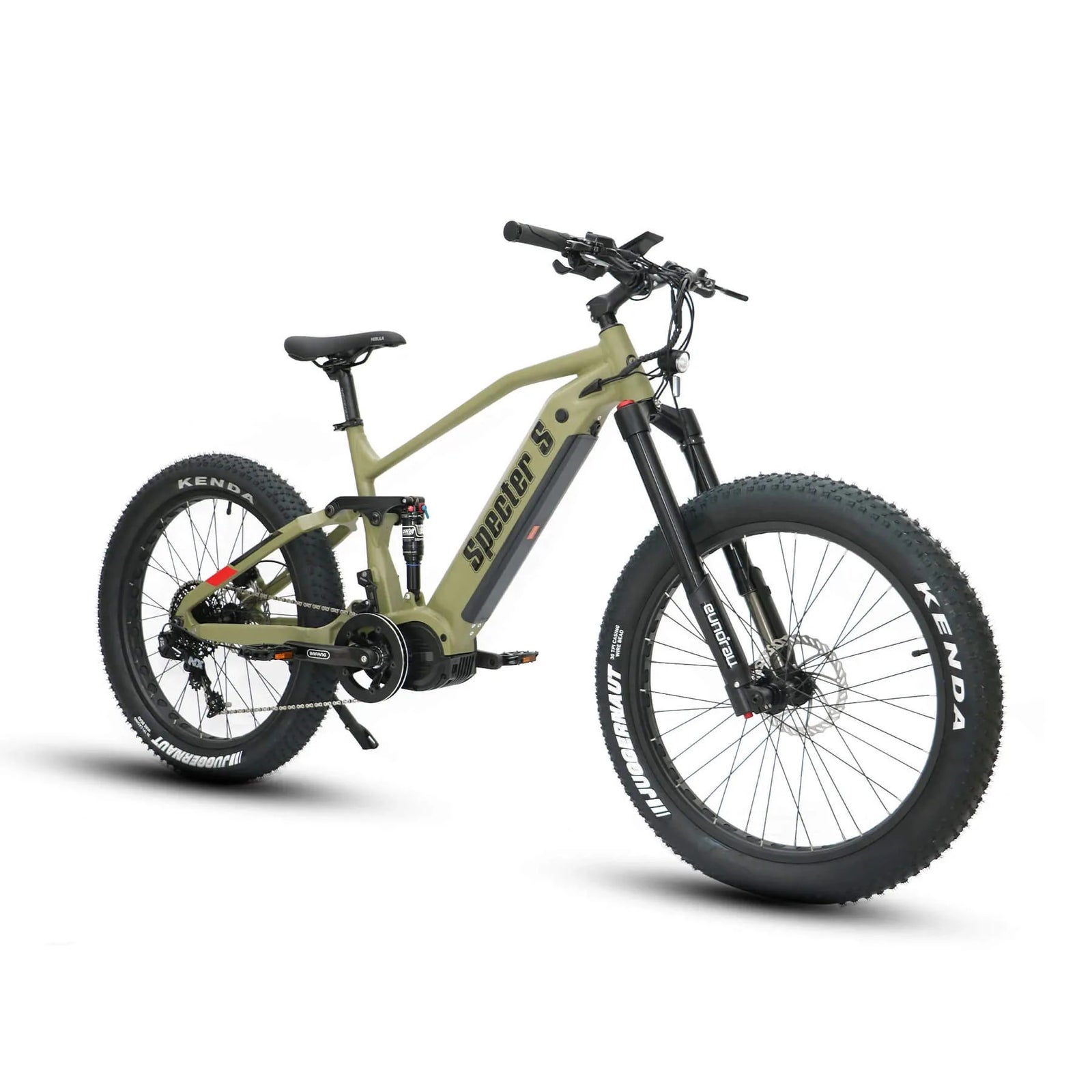
Fat tire e-bikes use tires that are 4 inches wide or more. They dominate the Canadian market at 36.9 percent of all listings. Wide tires absorb bumps, grip on snow and gravel, and provide stability at speed. Trade-offs: heavier weight, higher price, and increased rolling resistance on smooth pavement.
Fat tire bikes suit riders who want year-round use across trails, snow, and rougher surfaces. Average price is $1,764 in our dataset, with a median of $1,599.
Read our full fat tire e-bike buyer guide for specific model picks and legal risk analysis.
Folding e-bikes use a hinge system that lets the frame fold in half or telescope down to fit in a car trunk, apartment closet, or transit locker. They take 21.7 percent of Canadian listings. Wheel sizes range from 14 inch mini folders to 26 inch full-size folders.
Folding bikes suit apartment dwellers, riders with car trunk storage needs, or transit commuters. Average price is $1,108, with a median of $730. This is the most budget-friendly major category.
See our full folding e-bike breakdown for wheel size guidance and specific model recommendations.
Cruiser e-bikes use upright riding positions, wide swept-back handlebars, and comfort saddles. They target casual riders on flat surfaces. Frames are usually classic top-tube or step-through style.
Cruisers work well for short leisure rides, beach paths, and city streets under 15 kilometres per trip. They emphasize comfort over speed or off-road capability.
See our top cruiser picks with a 5-question fit finder.
Step-through e-bikes have a low or absent top tube. Riders swing a leg over a low frame rather than lifting it high. This helps shorter riders, older riders, and anyone in dresses or work gear. Step-through is a frame style rather than a distinct motor or wheel category. It can be combined with fat tire, cruiser, or commuter frames.
Read our step-through comparison of 18 models for picks by budget and use case.
Commuter e-bikes target daily transportation. They favour reliable range, integrated lighting, mudguards, cargo racks, and comfortable geometry for 10 to 30 kilometre rides. Wheel sizes are usually 26 or 28 inches. Motors sit at the federal 500W legal cap for road use.
Commuter bikes suit riders who replace car trips with a bike ride. Frame styles vary from step-through to classic top-tube.
Two common motor placements shape how an e-bike rides.
Hub motors sit inside the front or rear wheel. Rear hub is more common. Hub motors are simpler and cheaper to build. They can feel unbalanced on lighter frames because most weight sits at the rear.
Mid-drive motors sit at the crank between the pedals. This positions the weight at the frame center for better balance. Mid-drive delivers power through the drivetrain, which improves hill climbing. Trade-off: higher price and more mechanical complexity.
Riders under 5 feet 5 inches, or riders who commute in hills, benefit most from mid-drive motors.
Use these matching signals:
All frame types and motor placements can be built as federally legal power-assisted bicycles. The legal test is motor wattage (500W continuous cap) and assisted speed (32 km/h cap), not frame design. A fat tire e-bike with a 750W motor is above the federal limit. A fat tire e-bike with a 500W motor is road legal in most provinces.
Look at motor and speed specs, not frame style, when checking Canadian road legality.
Read the full provincial e-bike law breakdown.
Fat tire e-bikes lead at 36.9 percent of Canadian retail listings. Folding e-bikes follow at 21.7 percent. Together these two categories cover 57 percent of the market.
Mid-drive motors offer better balance and hill climbing. Hub motors cost less and require less maintenance. Shorter riders and hill commuters benefit most from mid-drive. Flat-terrain casual riders can save money with a hub motor.
Modern step-through frames use reinforced tubing to match top-tube strength for typical rider weight and load. They are not weaker in normal use. The difference is mount ease, not structural.
Folding e-bikes are the budget entry point at a median price of $730. Fat tire and commuter e-bikes cost more due to larger frames and higher wattage components.
Street Rides Research is a Canadian e-mobility research team based in Ontario. We track live retail pricing, verify provincial regulations against official government sources quarterly, and analyze verified buyer reviews.
See our SR Score methodology for how we rate every e-bike. Contact: info@streetrides.ca.
Comments will be approved before showing up.